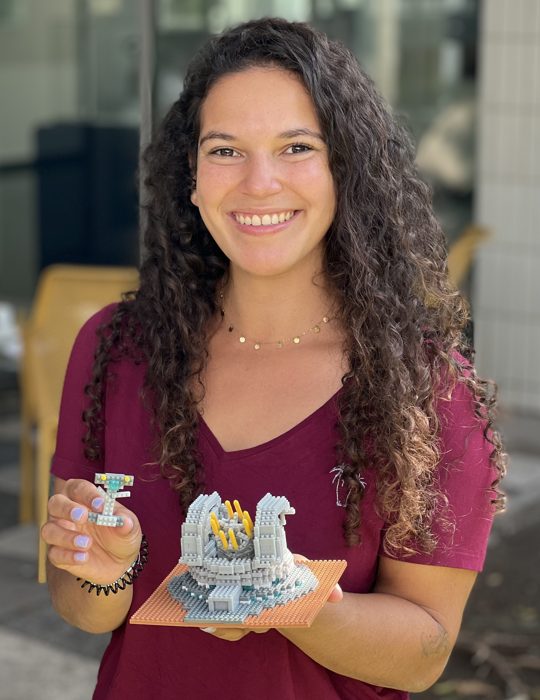
Emma Bordier holding a small model of a telescope

Emma Bordier

Astrophysicist · massive star formation & high-angular-resolution observations

Postdoctoral researcher, I. Physics Institute, University of Cologne

I study how the most massive stars assemble their mass and acquire their companions, using infrared interferometry (VLTI GRAVITY/MATISSE), adaptive optics and ALMA, from the Galactic Centre to the Magellanic Clouds.

About

From La Réunion to the stars (and back again)

I grew up on La Réunion, a tiny island in the Indian Ocean, and lived there until I was 18. Then came the sot la mèr, literally “jump the ocean”, as we say in Creole, to pursue my studies in mainland France. It was a big leap in more ways than one: I had to find my own path as a young scientist and as a woman in science.

My curiosity about the Universe started with one big question: are we alone? Astronomy seemed like the obvious way to investigate. One thing I had not realised back then? The night sky looks different depending on which hemisphere you are in. Turns out, even the stars have a change of scenery!

Since then, my journey has taken me across Belgium, Germany, Hawaii, Taiwan and Chile, with plenty of extra stamps from conferences along the way. I completed a joint PhD between KU Leuven and ESO in Santiago. My thesis, On the Origin of Massive Close Binaries, explored how massive multiple-star systems form. I am now a postdoc at the University of Cologne.

One of my favourite places in the world is an observatory. There is something magical about going there, standing at the edge of the unknown, and getting ready to discover something we have never seen before. I suppose I am a bit like a mad scientist heading into the lab to run an experiment, except my laboratory is a mountaintop, my experiments involve starlight, and sometimes the Universe and the clouds have other plans for the night!

When I am not studying the stars, I like getting a little closer to the sky the old-fashioned way: climbing and hiking in the mountains. I also love cycling and canyoning. Whenever I can, I return to La Réunion to tackle my favourite trails all over again. Same island, same paths, same enthusiasm. Apparently, I never get tired of a good view!

I also enjoy experimenting in the kitchen. I bake my own bread with the help of an ever-alive sourdough blob, and I love making cakes to celebrate my friends, who happily serve as my beta testers.

I also try to recreate a little tropical-jungle vibe in my German apartment, surrounding myself with plants as a way to compensate for the lack of sunshine (and vitamin D!).
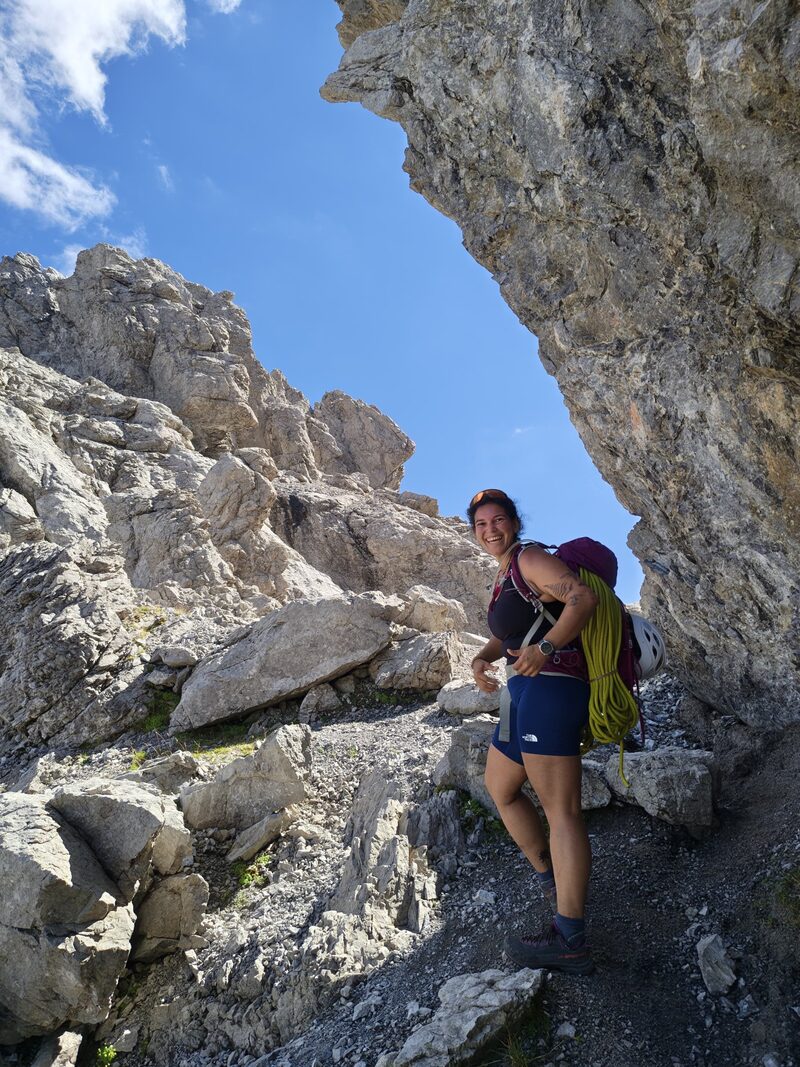
Emma smiling on a rocky mountain trail, carrying a climbing rope and helmet
NowPostdoc, University of Cologne (2024–2027)
PhDKU Leuven & ESO Chile, 2024. Advisors: H. Sana, A. Frost, W.-J. de Wit
Used facilitiesVLTI GRAVITY(+), MATISSE, PIONIER · ALMA · VLT VISIR, NACO, SPHERE
ToolsPython · PMOIRED · RADMC-3D
Research

How do massive stars come to life, and why do they rarely come alone?

Massive stars are among the most powerful objects in the Universe, shaping their surroundings and influencing how galaxies evolve. But how do these stellar giants form? And why do so many have companions?

I study the birth of massive stars and their stellar companions, following the journey from vast clouds of gas and dust down to the regions where stars take shape. Using some of the world’s most powerful telescopes, I zoom in on these stellar nurseries to investigate how material feeds growing stars and how pairs or groups of stars form together.

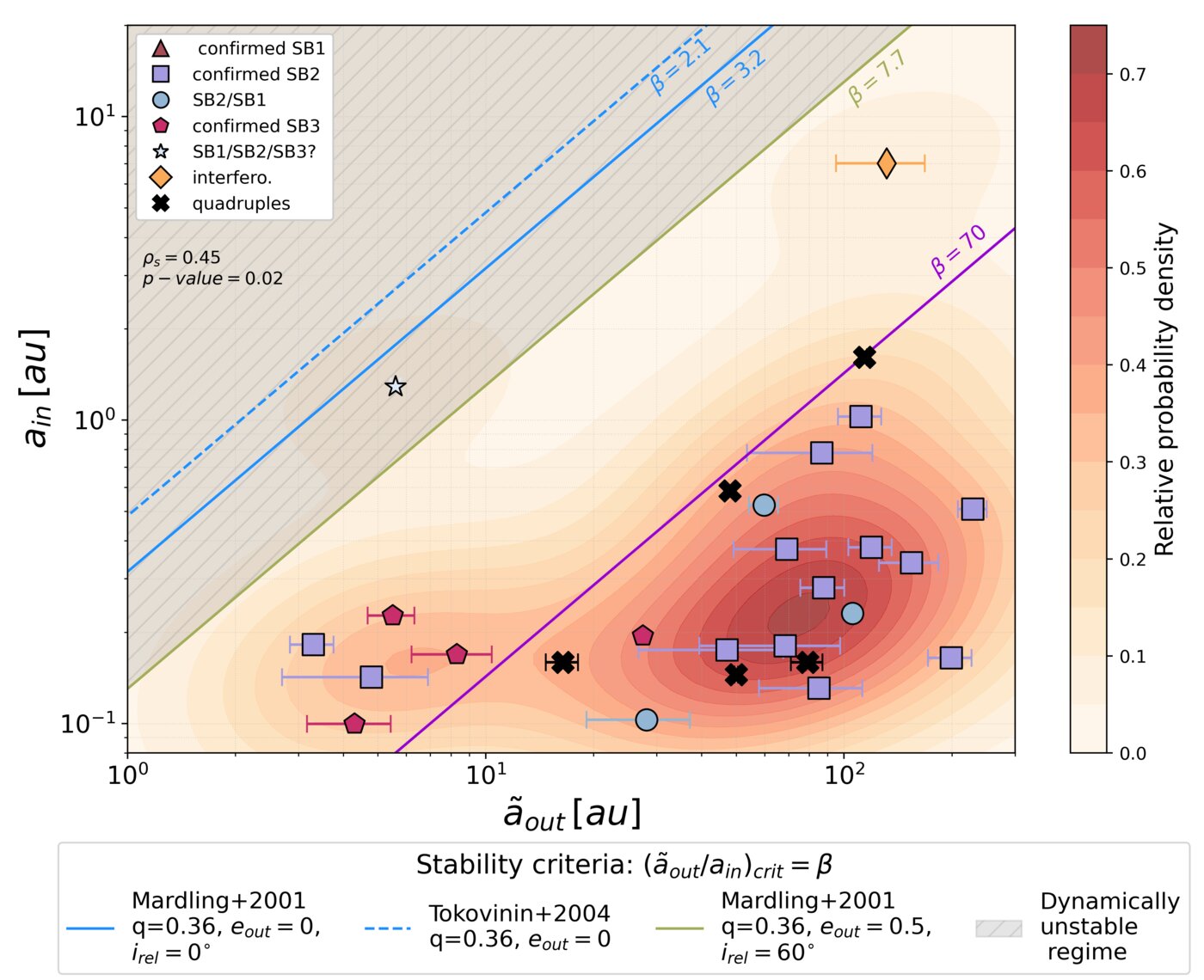
Inner versus outer semi-major axis of massive hierarchical triples compared with dynamical stability criteria
Inner vs. outer orbits of massive hierarchical triples, compared with stability criteria (Bordier et al. 2026).
01

Close multiplicity in populations of (young) massive stars

Using high-angular-resolution techniques such as VLTI interferometry, I look for close companions to massive stars. I study how these systems are built: binaries, and triples or higher-order systems.

Bordier et al. 2022 · Bordier et al. 2026

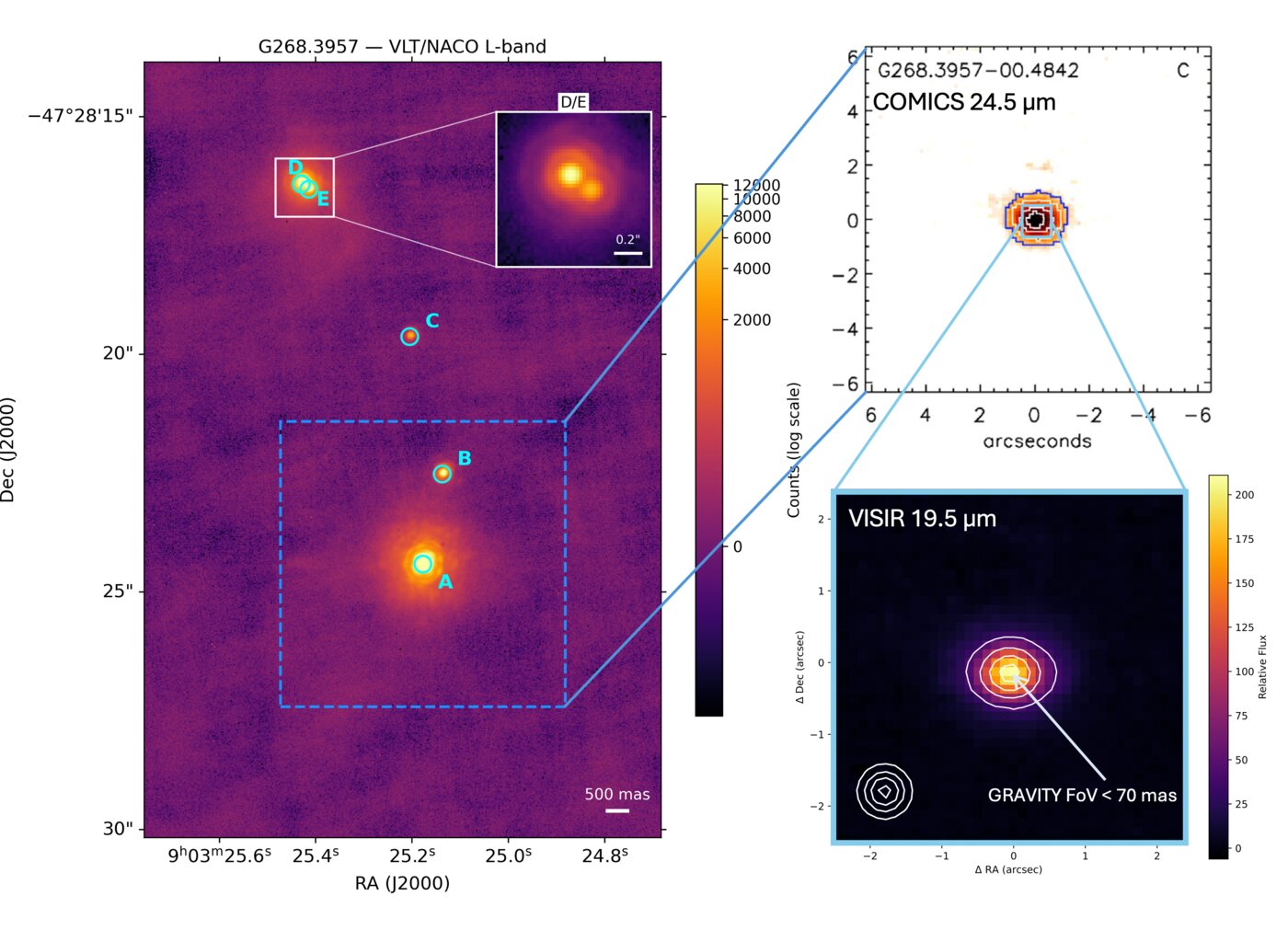
VLT/NACO L-band image of G268.3957 showing companions A to E, with COMICS and VISIR mid-infrared insets
Companions around a massive young stellar object seen with VLT/NACO, with mid-infrared views from COMICS and VISIR.
02

Wider companions in the youngest systems

Slightly wider companions (10²–10⁴ au) around massive stars that are still accreting tell us how multiple systems form in the first place, before migration and dynamics erase that information.

Bordier et al. 2024

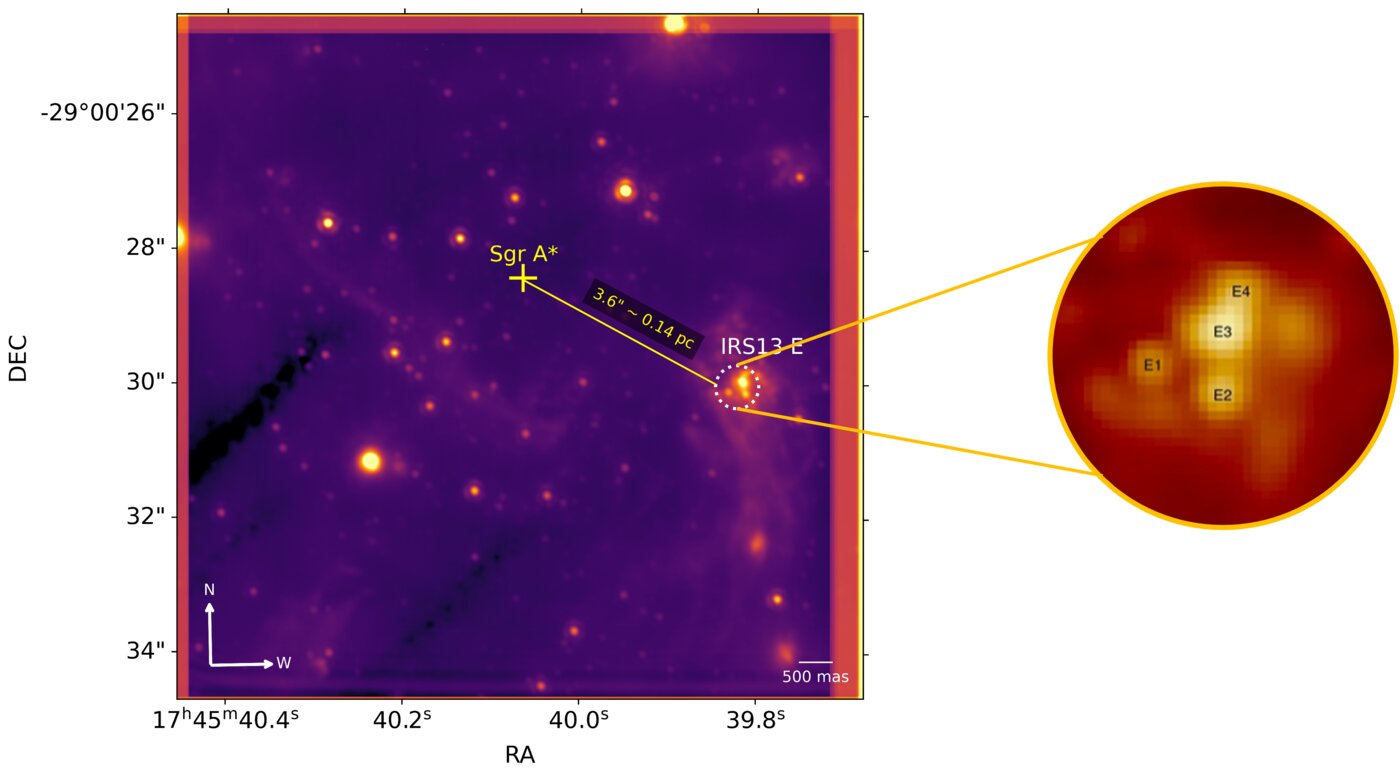
Infrared image of the Galactic Centre showing Sgr A* and the IRS 13E cluster 3.6 arcseconds away, with a zoom on sources E1 to E4
IRS 13E, a compact cluster 0.14 pc from Sgr A*, the supermassive black hole at the centre of the Milky Way.
03

Massive stars in extreme environments

I probe the infrared environment of massive stars in unusual places, such as the Galactic Centre. There I lead the first VLTI/MATISSE study of IRS 13E, using radiative-transfer modelling of the interferometric data.

Bordier et al., in prep.

Looking forward. What comes next for high-angular-resolution studies of massive star formation? In a white paper for ESO’s Expanding Horizons initiative, we make the case for next-generation thermal-infrared interferometers to resolve the smallest scales of massive star formation. Read the white paper (Bordier, Koumpia, Labadie et al. 2026) →
Selected papers

First-author publications

Three steps back in time: from hierarchical triples on the main sequence, to ~1 Myr-old O stars, to stars that are still accreting.

I am also co-author on work about Betelgeuse’s candidate companion (Montargès et al. 2026), a binary in the S cluster near Sgr A* (Peißker et al. 2024, Nat. Commun.), Wolf-Rayet binaries (Deshmukh et al. 2024) and HR 6819 (Frost et al. 2022). Full list on ADS →

Observing

Observing programmes I lead

Facilities and instruments I use: VLTI (GRAVITY, GRAVITY+, MATISSE, PIONIER) · VLT (VISIR, NACO, SPHERE) · ALMA · and soon ELT/METIS.

ALMAMultiplicity and dynamics in embedded massive star-forming clusters
VLTI / GRAVITY+Opening the extragalactic frontier: massive young stars in the Magellanic Clouds
VLT / VISIRFinding massive protostellar disks through silicate emission among ALMAGAL sources
VLTI / GRAVITYTesting binarity and the migration scenario among M17 MYSOs
VLTI / GRAVITYTesting the migration scenario in M17 for close massive binaries
Talks & outreach

Sharing the science

“To be like you.”A six-year-old girl who came to my workshops every day of an astronomy festival, when I asked what she wanted to be when she grows up. Those words will always resonate with me, and remind me that I chose the right path.

Selected talks in conferences

  • Cologne–Bonn Symposium: Habitats of massive stars across cosmic time
  • EAS 2026, Lausanne: 3 contributed talks and session chair (SS30)
  • IAU Symposium 405, Brno: the Galactic Centre
  • VLTI Community Days, ESO Garching
  • Invited talk, EAS 2025, Cork
  • Talk and invited panelist, Horizons for Optical Long Baseline Interferometry, Meudon
  • POEMS: Physics of Extreme Massive Stars, Rio de Janeiro

Outreach

  • Public talks for the French Science Week, La Réunion
  • Week-long exhibition guide & workshops on the 2026 eclipse, Festival de la Plage aux Étoiles, Collioure
  • Led the University of Cologne press release on Betelgeuse’s companion
  • Articles in the outreach magazine Science Vega
  • Meet a scientist: Astronomy on Tap (Cologne) and Astronomía al Parque (Santiago)
  • Interviews on France Culture radio and KULT Media
  • Women in STEM talk, Lycée Bellepierre, La Réunion
  • Letters to a Pre-Scientist
Teachers, get in touch! I love visiting schools, for special occasions like Science Week or for regular classes. I am happy to do one-day visits as well as longer projects with kids, in person or online, especially for schools in La Réunion. I can speak with your class in French, Creole, English or Spanish. Email me.
CV

Career

Postdoctoral researcherI. Physics Institute, University of Cologne, Germany
PhD in AstrophysicsKU Leuven & ESO (ESO Student in Santiago, Chile, 2021–2023)
MSc Astronomy & AstrophysicsUniversité Paris-Saclay & Observatoire de Paris. Thesis at CFHT, Hawaii
BSc Fundamental PhysicsUniversité Paris-Saclay
Community

Service & mentoring

  • SOC member, VLTI School 2027 (ESO Garching)
  • Co-supervisor of a PhD student; supervisor of Master’s and Bachelor’s students
  • Diversity Board, CRC 1601, Cologne
  • LOC/organiser of meetings in Cologne, Leuven and Santiago
  • Reviewer for A&A, ESO and ALMA proposals
  • Teaching assistant: optical/IR interferometry, infrared methods, advanced astrophysics